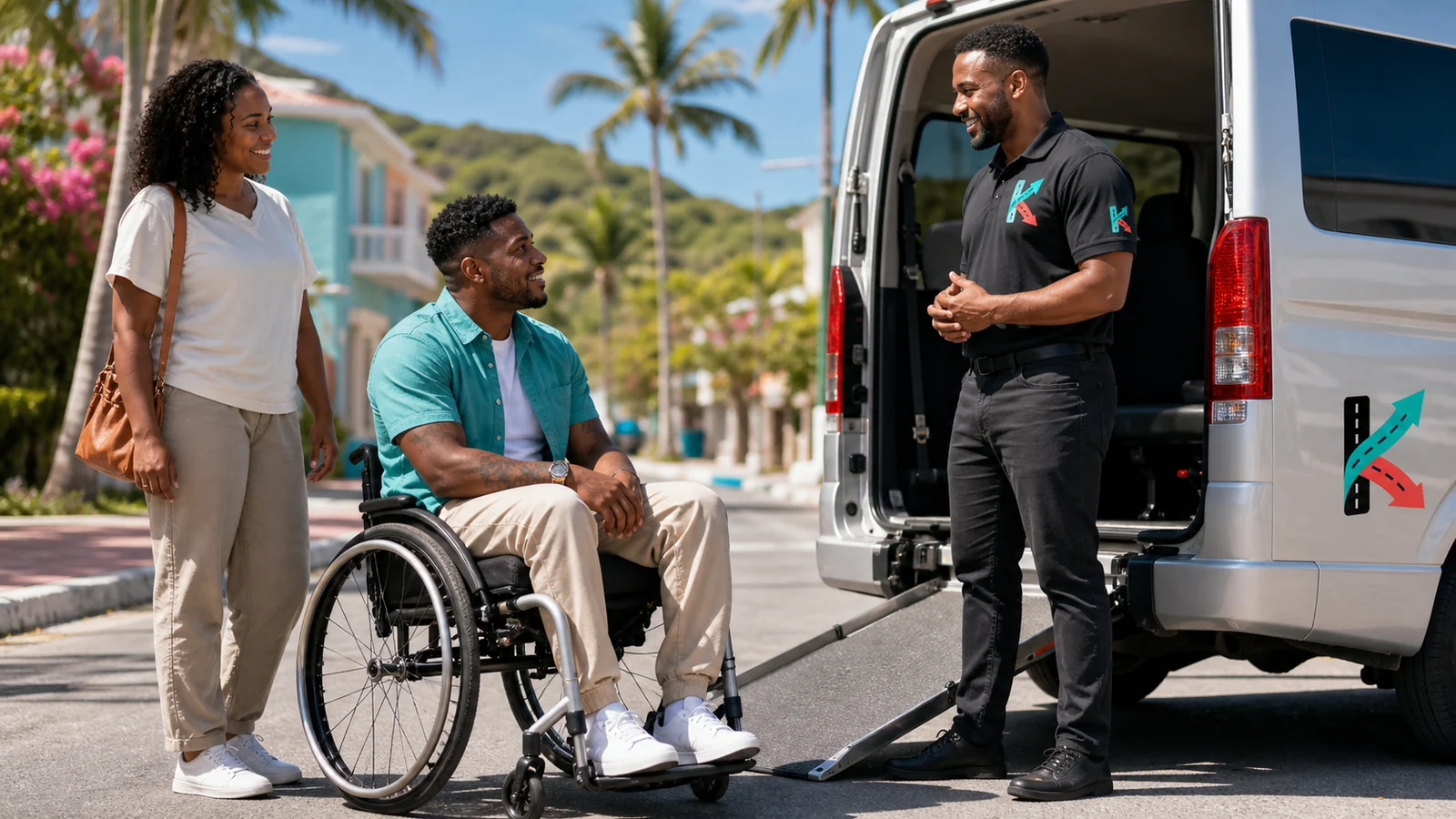
Short answer: KiloDrive's assisted-rider design is intended to let a person voluntarily describe practical trip needs—such as boarding time, wheelchair dimensions, a service animal, a communication preference or a caregiver contact—so the platform can match only drivers and vehicles that are capable and willing. It must never guess a disability from trip history, and it must remain unavailable in a country until legal, operational and end-to-end safety review is complete.
Accessibility is not a single checkbox. A wheelchair user may need dimensions and securement information, a person with low vision may prefer spoken arrival details, and a Deaf rider may prefer text. Another rider may need extra time but no specialized vehicle. Treating all of those people as one category creates poor matches and discloses more information than a driver needs.
What this means The rider chooses whether to create an assistance profile, controls the practical information supplied for a trip, and should see exactly what a prospective driver can receive. The feature is support for autonomy—not a diagnosis or a promise that every vehicle is accessible.
Ask about the trip need, not the diagnosis
The profile design focuses on functional information: mobility and boarding support, wheelchair measurements where genuinely needed, service-animal context, hearing or vision communication preferences, extra boarding time and an optional caregiver contact. A rider should be able to edit or remove those preferences and decide which ones apply to the current trip.
KiloDrive should not infer disability from location, previous destinations, assistive-device searches or support messages. Jamaica's Office of the Information Commissioner describes data minimisation as collecting only information relevant to the stated purpose. In practice, a driver may need to know that extra boarding time was requested or that a folded mobility aid must fit; the driver usually does not need a medical history.
A caregiver contact is also not an automatic supervisor. Contact or trip sharing needs an explicit role and trip-scoped permission. Adult riders retain control over who sees their live location and for how long, subject to applicable safety and legal duties. The information should expire from the active operational channel when the trip closes while legally required records follow a reviewed retention policy.
Capability matching must be honest
An accessibility request should narrow matching to drivers and vehicles that have declared the relevant capability and consented to provide it. A label in a profile is not enough: the vehicle configuration, current compliance, space and equipment need verification appropriate to the requirement. If no suitable option is available, KiloDrive should say so clearly rather than send an incompatible vehicle.
The same honesty applies at pickup. Drivers need a concise, voice-readable summary before accepting, but the interface should avoid unnecessary sensitive detail. The rider needs a way to confirm the vehicle and restate a request. Neither side should be penalized automatically because noisy telemetry, an ambiguous note or a one-off delay is interpreted as refusal. Concerns should go to a structured support and appeal path.
Jamaica's Disabilities Act came fully into effect on 14 February 2022. Government explanations identify equal rights, dignity, independence and access to public passenger vehicles among its concerns. The UN Convention on the Rights of Persons with Disabilities likewise connects accessibility with transportation, information and communications. Those sources establish important principles; they do not by themselves certify KiloDrive's specific workflow or decide the obligations of each provider in every case.
Accessible software is part of the ride
A physically capable vehicle is not useful if the booking controls cannot be operated. The app and Portal should support platform text scaling, screen readers, logical focus, 48dp targets, sufficient contrast, keyboard access and plain error messages. W3C explains that WCAG applies across web and mobile contexts, including users with vision, hearing, movement and cognitive disabilities.
Important actions cannot depend on colour alone. A map needs a textual alternative, a status change needs a screen-reader announcement, and chat needs an accessible way back. The rider should be able to reach the primary action when the keyboard, gesture bar or large text is present. A denied permission or failed location fix should explain the effect without trapping the user.
Safety without paternalism
Assistance information should improve preparation, not reduce a rider's choices. The driver must not receive an invitation to make medical judgments. The rider should not be forced into caregiver monitoring merely for requesting help. Emergency controls and KiloDrive's Safety information remain available under the same country policy, while a support case can document an accessibility problem without publishing sensitive details.
Drivers also need training and a clear way to declare what they can safely provide. Capability is not goodwill alone. Incorrect lifting, securement or equipment handling can cause harm, so the feature should distinguish ordinary courteous assistance from a specialized service that requires equipment, training or regulatory approval.
What is still uncertain
Assisted-rider mode is a separately gated product. Its availability, supported needs, driver training, vehicle standards, service-animal handling, caregiver role, emergency procedure and complaint route require country-specific legal and operational approval. KiloDrive should not expose the booking option until the active country registry marks those dependencies ready and end-to-end tests pass. Nothing in this article promises availability, a particular accommodation or legal compliance for an individual trip.
Frequently asked questions
Does KiloDrive automatically decide that I have a disability?
No. The assisted-rider design is opt-in and should collect only the practical needs a rider chooses to provide for the stated purpose.
Does requesting assistance guarantee a suitable vehicle?
No. The system must confirm a capable, consenting driver and compatible vehicle. If none is available, it should say so rather than promise an unsuitable match.
Will a driver see my medical history?
No. A driver should receive only the minimum trip-relevant assistance information and not a diagnosis or unrelated medical history.
Can a caregiver automatically track an adult rider?
No. Caregiver contact and live tracking require an explicit role and appropriate trip-scoped consent; paying for or arranging a ride is not unlimited access.
Is assisted-rider mode available in every KiloDrive country?
No. It must remain unavailable until the selected country has completed the required legal, operational, vehicle, driver and safety certification.
Sources
- 13 of 2014 — The Disabilities Act — Laws of Jamaica.
- The Disabilities Act comes into effect February 14, 2022 — Ministry of Labour and Social Security, Jamaica.
- Disabilities Act — Jamaica Information Service.
- Article 9 — Accessibility — United Nations.
- Web Content Accessibility Guidelines 2.2 — World Wide Web Consortium.